ECLIPSE: Evolutionary Computation Library for Instrumentation Prototyping in Scientific Engineering
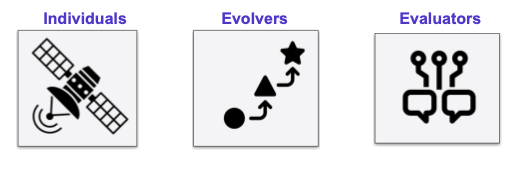
ECLIPSE is a general framework for the evolutionary design of hardware in space-science domains. It provides a modular architecture consisting of Individuals, which encode hardware designs using physically constrained representations; Evaluators, which translate simulation outputs into fitness measures; and Evolvers, which implement EC algorithms.
Goal & Motivation
Designing space-science hardware is a complex, expensive, and highly iterative process. Traditional engineering workflows rely on expert-driven design followed by extensive simulation and refinement cycles, which can be time-consuming and limit the exploration of unconventional geometries. Evolutionary computation (EC) offers an appealing alternative: by automatically exploring large, high-dimensional design spaces, EC can discover high-performing and sometimes unintuitive solutions that human designers may overlook.
However, applying evolutionary methods to new scientific hardware remains challenging because most scientific simulation tools were not originally developed with evolutionary workflows in mind. They are often optimized for accuracy rather than high-throughput evaluation. ECLIPSE provides the integration layer needed to couple evolutionary search with real scientific modeling environments in a consistent, extensible, and domain-aware manner.
Reusable Software Infrastructure
The ECLIPSE framework underpins all Nebulous projects, providing shared evolutionary algorithms, geometry encodings, solver interfaces, and orchestration tools. A key research theme is extending ECLIPSE so that new classes of instruments can be brought into the framework with minimal additional effort. By separating representation, evaluation, and evolutionary logic, the framework enables interdisciplinary teams to explore unconventional hardware geometries while utilizing well-established scientific modeling tools.
Results & Updates
Who are we?
Contributing Team

Dr. Julie Rolla

Dr. Emily Dolson

Dr. Charles Ofria

Max Foreback
Dr. Vincent Ragusa

Evan Imata
Christina Shao

Joey Wagner