LEO: cLuster Evolved Observatory
LEO is an AI-driven framework for designing antenna arrays and observatory clusters. By co-optimizing element topology and relative placement simultaneously, LEO leverages evolutionary, multi-objective optimization to navigate complex trade spaces, ensuring robust performance under real-world mission constraints.
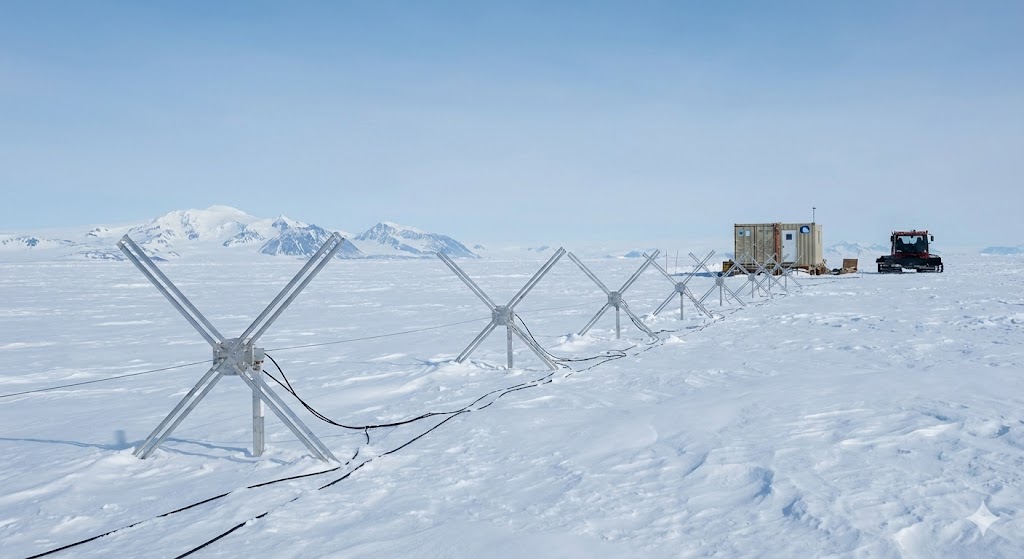
(Concept: Distributed observatory array deployed in extreme environments)
Goal & Motivation
LEO applies AI-guided design to distributed observatories, antenna arrays, sensing systems, and communication architectures, where performance depends not only on individual element design, but on configuration, coupling effects, environmental conditions, and mission- or application-driven tradeoffs. Evolutionary, multi-objective methods can explore these large design spaces, identify robust solutions, and quantify performance and uncertainty in ways that are difficult to achieve through expert-driven iteration alone.
A central driver is operational realism: advanced system design must satisfy aggressive performance goals within tight cost, schedule, risk, and deployment constraints. LEO supports faster, more defensible trade studies early in formulation -- when configuration choices have the highest leverage and late-stage changes are most costly, while maintaining physics-based evaluation and traceability to system requirements.
Primary objective
Enable end-to-end, requirement-driven optimization of observatory clusters by co-designing array element topology and relative placement.
Why evolutionary optimization
Array design spaces are high-dimensional and strongly coupled; evolutionary search supports rapid exploration, multi-objective trade-offs, and discovery of non-intuitive configurations with interpretable trade spaces.
Results & Updates
Who are we?
Contributing Team

Dr. Julie Rolla

Dr. Emily Dolson

Dr. Amy Connolly

Dr. Charles Ofria

Dr. Bryan Reynolds

Dr. Wolfgang Banzhaf

Dr. Anselmo Pontes

Dr. Rajiv Ramnath

Kate Skoceles

Aman Hafez

Jacob Weiler