FACET: Fabricated Antenna with Computationally-Evolved Topology
FACET utilizes a novel constructive geometry approach, using LEGO-like blocks to build and construct antenna designs. By combining primitive shapes—such as cuboids, cylinders, and cones—the system evolves complex geometries capable of meeting rigorous scientific requirements.
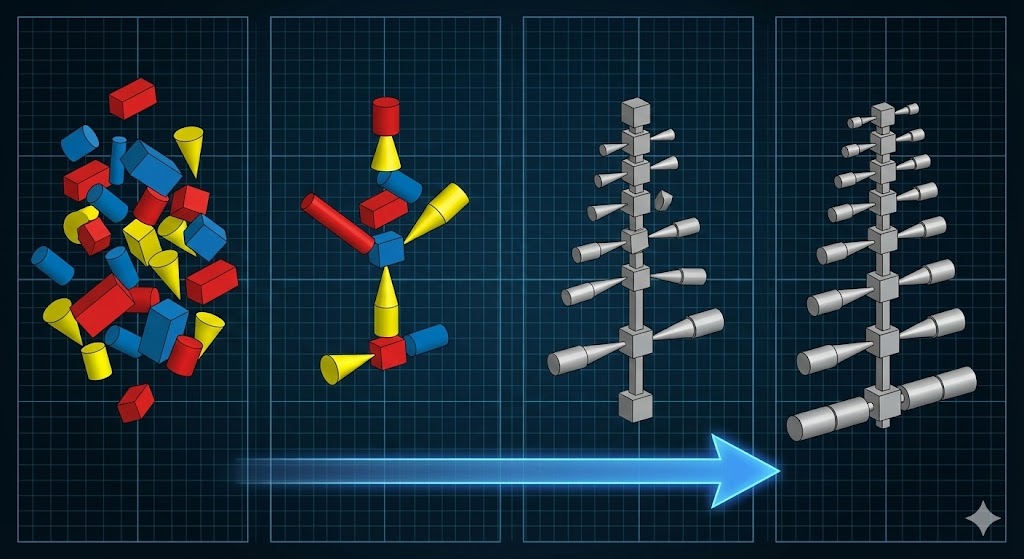
(Diagram: Evolutionary antenna construction via primitive shapes)
Goal & Motivation
AI-driven instrument and antenna design offers a largely untapped opportunity to improve the performance of future science and engineering systems. This is especially valuable in regimes where conventional design approaches can fall short: weak or rare signals, complex geometric or deployment constraints, tightly coupled performance requirements, and measurements dominated by backgrounds or systematic uncertainties.
By navigating large parameter spaces, optimizing across multiple objectives, and predicting performance under realistic conditions, AI-guided design can identify buildable concepts that traditional approaches may miss. These methods can help open new measurement regimes while respecting practical limits on cost, schedule, manufacturability, and operations.
The opportunity extends across space science, Earth observation, communications, remote sensing, environmental monitoring, and advanced instrumentation. Rather than applying AI only downstream during data analysis, Nebulous focuses earlier: designing the hardware that determines what can be measured, detected, or transmitted in the first place.
Results & Updates
Who are we?
Contributing Team

Dr. Julie Rolla

Dr. Emily Dolson

Dr. Amy Connolly

Dr. Bryan Reynolds

Dr. Charles Ofria

Dr. Wolfgang Banzhaf

Dr. Anselmo Pontes
Dr. Vincent Ragusa

Max Foreback

Jacob Weiler

Evan Imata
Christina Shao